"What's that pink flower?" is the most common question anyone asks when they spot a bloom and want to know what it is. Color is the fastest filter — you can ignore the 90% of species that aren't your color and focus on the 10% that are. The catch is that "pink" includes thousands of species, and color alone is rarely enough for a positive ID. But it's a great place to start.
This is a practical reference guide to identify flowers by color, organized by the six colors people most commonly search for. Each color section covers the most likely candidates, what to look at next to narrow down the ID, and notes on the species you'll see most often.
Why color alone isn't enough
Before we dive in, an honest caveat: many flower species exist in multiple colors. Roses come in white, pink, red, yellow, orange, and bicolor. Tulips, irises, daylilies, and dahlias are similarly variable. So "blue flower" eliminates roses but doesn't eliminate irises (some irises are blue, some are yellow, some are purple).
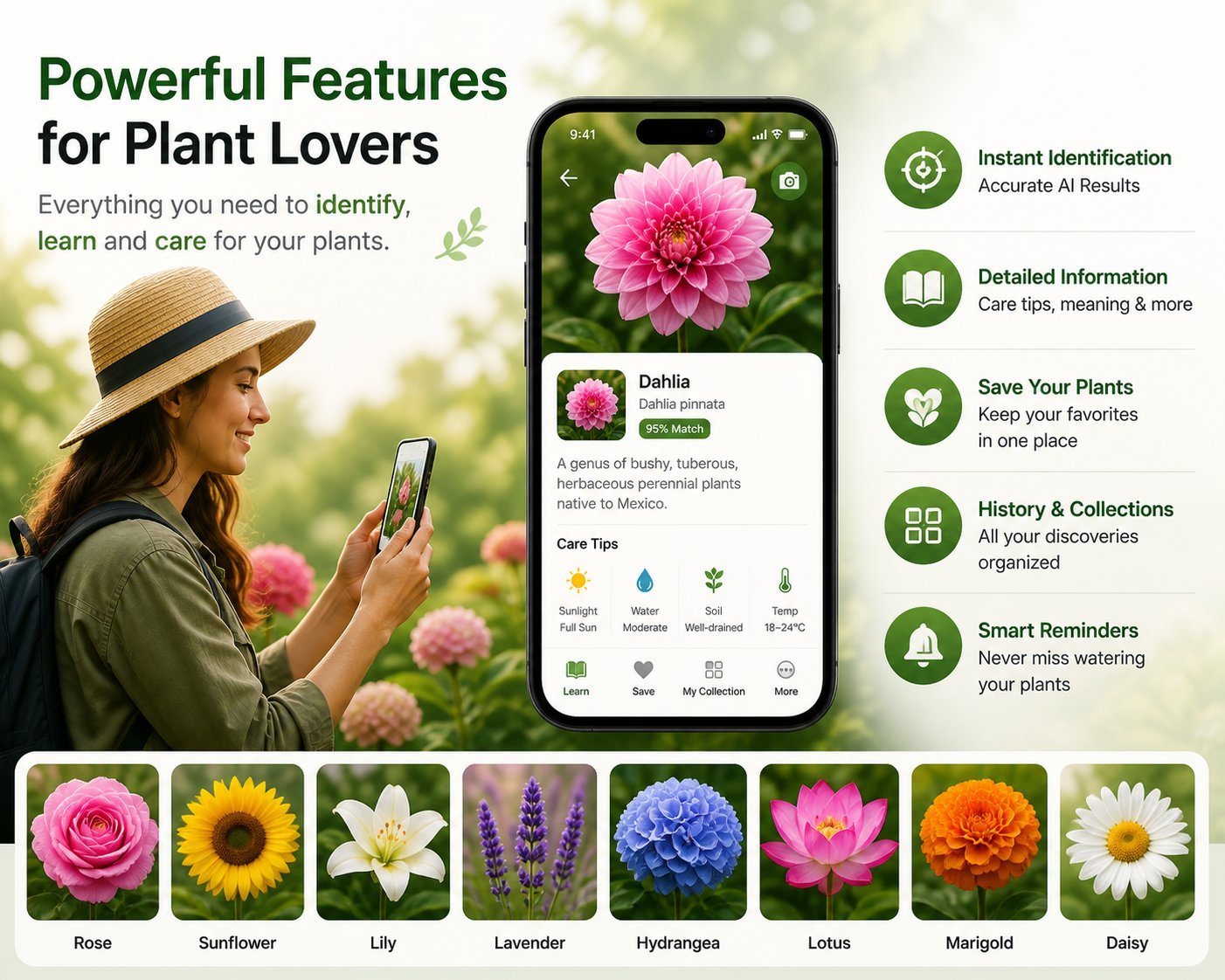
The honest method: use color to narrow down to a manageable list (10-30 species), then look at petal count, flower shape, and leaf type to land on the species. Or just take a photo and run it through a flower identifier app — color is the AI's first feature too.
White flowers
White is the most common flower color globally. Common white flowers you might encounter:
- Daisy (Bellis perennis) — small, with yellow center, lawns and meadows
- Lily of the valley (Convallaria majalis) — small bell-shaped blooms on a single stalk, woodland
- Magnolia (various species) — large waxy blooms, trees
- Dogwood (Cornus florida) — four-petal flowers (actually bracts), tree, spring
- White rose (Rosa hybrids) — many petals, thorny stem
- Calla lily (Zantedeschia aethiopica) — funnel-shaped, single petal-like spathe
- Snowdrop (Galanthus nivalis) — early spring, three drooping outer petals
- White trillium (Trillium grandiflorum) — three petals, three leaves, woodland spring
The fastest way to narrow a white flower: count the petals (3, 4, 5, 6, or many?) and look at the leaves.
Purple flowers
Purple is one of the most asked-about colors because so many native wildflowers fall into it. Common purple flowers:
- Lavender (Lavandula) — small flowers in spikes, woody stems, fragrant
- Iris (Iris spp.) — large showy flowers with three falls and three standards
- Pansy and viola (Viola) — small, often with a distinctive face pattern
- Lilac (Syringa vulgaris) — small flowers in dense clusters, woody shrub, very fragrant
- Wisteria (Wisteria sinensis) — drooping clusters, climbing vine
- Verbena (Verbena spp.) — small clustered flowers, low growing
- Aster (Symphyotrichum) — daisy-like with yellow center, late summer to fall
- Bee balm (Monarda) — raggedy spiky head, mint family (square stem)
- Crocus (Crocus spp.) — early spring, six tepals, low
- Allium (Allium spp.) — globe of small flowers on a tall stem, onion family
Yellow flowers
Yellow flowers are summer's color across most of the temperate world. Common candidates:
- Sunflower (Helianthus spp.) — large, daisy-like, yellow ray petals, dark or yellow center
- Black-eyed Susan (Rudbeckia hirta) — yellow petals, black center
- Daffodil (Narcissus) — six tepals, central trumpet
- Marigold (Tagetes) — many petals, strong scent, garden plant
- Buttercup (Ranunculus) — five waxy yellow petals, lawns and fields
- Goldenrod (Solidago) — tall spikes of small flowers, late summer
- Yellow water lily (Nuphar lutea) — floating on ponds
- Forsythia (Forsythia) — early spring, bare branches covered in yellow flowers
- Dandelion (Taraxacum) — composite flower with many ray petals, lawns
- Coreopsis (Coreopsis) — daisy-like, often with red center
Pink flowers
Pink is everywhere in spring. Common pink flowers:
- Rose (Rosa) — many petals, thorny stems
- Cherry blossom (Prunus serrulata) — small five-petal flowers covering bare branches in spring
- Peony (Paeonia) — large multi-petaled blooms
- Hibiscus (Hibiscus) — large funnel-shaped, often with prominent stamens
- Azalea (Rhododendron) — clusters on woody shrubs
- Pink dogwood (Cornus florida 'Rubra') — four bracts, tree
- Foxglove (Digitalis purpurea) — bell-shaped flowers on a tall spike
- Pink lady slipper (Cypripedium acaule) — pouched orchid, woodland
- Cosmos (Cosmos bipinnatus) — daisy-like, feathery foliage
- Sweet pea (Lathyrus odoratus) — pea-family flower, climbing vine, fragrant
Blue flowers
True blue is rare in nature, which is why blue flowers are so striking. Most "blue" flowers are actually purple-blue, but here are the genuinely blue ones:
- Bluebell (Hyacinthoides non-scripta) — drooping bell-shaped flowers on a curved stem
- Forget-me-not (Myosotis) — tiny blue flowers with yellow center, low growing
- Cornflower (Centaurea cyanus) — distinctive ragged blue petals, fields
- Morning glory (Ipomoea) — funnel-shaped, climbing vine
- Hydrangea (Hydrangea macrophylla) — large pom-pom clusters; blue in acidic soil
- Bluebonnet (Lupinus texensis) — pea-family spike, Texas wildflower
- Delphinium (Delphinium) — tall spikes, garden plant
- Periwinkle (Vinca minor) — small blue-violet flowers, ground cover
- Chicory (Cichorium intybus) — sky-blue rays, roadsides
Red flowers
Red flowers are often pollinator-attracting (especially for hummingbirds). Common reds:
- Red rose (Rosa) — the classic
- Red tulip (Tulipa) — six tepals, spring
- Cardinal flower (Lobelia cardinalis) — bright red tube-shaped flowers on a tall spike, wet meadows
- Geranium (Pelargonium) — clusters on patio plants
- Red poppy (Papaver rhoeas) — papery petals, dark center
- Bee balm (Monarda didyma) — red form of bee balm, square stems
- Hibiscus (red-flowered) — large funnel
- Indian paintbrush (Castilleja) — red-orange bracts, western wildflower
- Salvia (red varieties) — tall spikes of tubular flowers, mint family
- Anemone (red cultivars) — five to nine petals, cup-shaped
How to use color in a flower identifier app
If your flower identifier app has a "browse by color" feature, use it as a sanity check after AI identification. Confirm the candidate species is in the right color family. If the app says "white iris" but your flower is purple, the species is wrong even if the genus is right.
Some apps let you filter results by color. This is especially useful when the AI returns 2-3 candidate species and they're different colors — the right one is obvious.
Going beyond color
Once color narrows the field, the next features to look at are:
- Petal count — 3, 4, 5, 6, or many?
- Flower shape — flat, cup, bell, trumpet, irregular?
- Cluster pattern — single bloom, spike, cluster, umbel?
- Leaf shape — simple, lobed, compound, needle?
- Habitat — garden, meadow, forest, water?
Color + petal count + leaf shape will narrow virtually any North American garden or wildflower to fewer than 10 candidates. From there, an AI app or a field guide can finish the ID.
Final thought
Color is the entry point but not the whole story. The fastest way to identify flowers by color is to combine color filtering with one or two other features — petal count, leaf shape, or habitat. Or just photograph the flower and let an AI app do the work. Either way, color is rarely a complete answer on its own.
Try Flower Identifier — free on iPhone
AI-powered flower ID from a single photo. Bloom, leaf, or whole plant. No account required.
Download on the App Store