
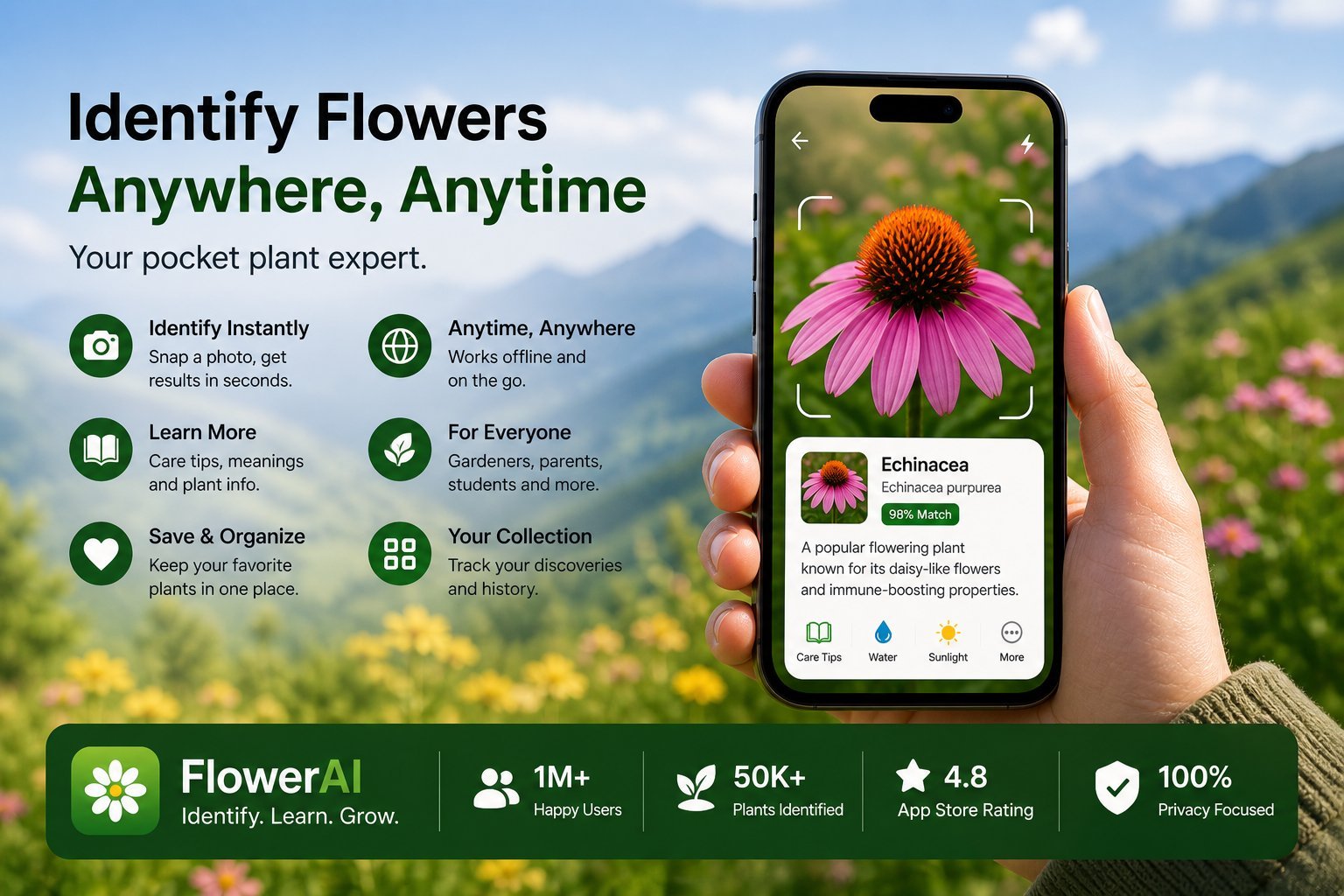
Search the App Store for "free flower identifier app" and you'll find dozens of apps with the word "free" right in the title. Download the top result and you'll get three free scans, then a paywall asking $39.99 a year. The next app gives you a 3-day free trial that auto-converts. The third gates the species name and only shows you the bloom photo unless you subscribe.
Some apps really are free. Some are free in name only. This guide breaks down the difference and helps you find a flower identification app that actually lets you identify flowers without reaching for your credit card.
The four flavors of "free" in flower ID apps
Genuinely free, ad-supported
A small number of apps are fully free and pay for the AI inference cost with display advertising. PlantNet is the best-known example — it's a nonprofit citizen-science project, no subscriptions, no in-app purchases. The trade-off is fewer features, less polished UX, and no premium support.
Genuinely free, donation-supported
iNaturalist's Seek app is free with no ads and no paywalls. iNaturalist is a partnership between the California Academy of Sciences and National Geographic, and donations cover the cost of running it. It's deliberately educational and conservative — it won't always commit to a species — but it's a legitimately free option.
Free tier with limits ("freemium")
Most popular flower identifier apps, including Flower Identifier, fall into this category. You get a real free tier (3-10 free identifications per week, full feature access for those scans) and pay only if you exceed it. This is the most honest model — the company has costs, you get to try the product, and you only pay if you become a real user.
"Free trial" that's really a subscription
The aggressive end of the market. The app is "free to download" but every feature is gated behind a 3-day or 7-day free trial that auto-converts to an annual subscription unless you cancel. If you don't read the App Store carefully, you'll be charged $40-$60 the day after you forgot the app exists. App Store Refunds are sometimes possible but never guaranteed.
How to spot the trial-to-subscription bait before you download
The App Store tells you everything if you know where to look. On any flower identifier app's listing:
- Scroll to "In-App Purchases." If the cheapest option is $39.99/year and there's no weekly or monthly option, the free trial is almost certainly the only "free" thing you'll get.
- Read the most recent 1-star reviews. Filter for "subscription," "charged," or "refund." If multiple users report being auto-charged after a free trial, that's the business model.
- Check the developer's other apps. Companies with 30+ apps in the same template often run trial-to-subscription on all of them.
- Look for actual price disclosure on the App Store screenshots. Reputable apps show the price clearly. Hidden pricing is a red flag.
The most useful free options in 2026
Flower Identifier (free tier)
Free to download, includes a generous free tier of identifications per week. No ads, no account, full access to species detail, history, and PDF export within the free tier. Premium unlocks unlimited scans for $4.99/week or $9.99/month.
PlantNet
Fully free. Strong for European flora, weaker for North American native species. The species detail is sparse — you get the name and a Wikipedia link.
Seek by iNaturalist
Fully free. Family-friendly with a gamified "challenges" feature for kids. Conservative IDs (often genus-level only) but very accurate when it does commit. No species detail beyond the name and a link to iNaturalist's web page.
Google Lens
Already on your phone if you have the Google app or a Pixel. Fully free. The downside: it's not really a flower identifier — it's a visual search. You get image matches, not a species name with structured data.
Why apps charge money in the first place
It's worth understanding the cost structure. When you point your camera at a flower and tap "identify," the photo is sent to a cloud server running a vision model. That server costs money — typically $0.001 to $0.01 per inference, depending on the model. If you do 10 identifications, the company has spent maybe a dime on you. If a million users each do 10 free scans, that's $100,000 a month in compute costs alone, before salaries, design, support, marketing, and Apple's 30% cut.
This is why fully-free apps are rare. Either there's a sponsor (PlantNet, iNaturalist) or there's a subscription model. Apps claiming to be entirely free with thousands of free scans are usually pulling a different lever — selling your data, training their models on your photos, or running an aggressive ad strategy.
What "free" should actually include
A reasonable free tier for a flower identification app, in my view, includes:
- Enough free scans to genuinely test the app — at least 3 per session or 10 per week
- Full species detail on free identifications, not a teaser
- The ability to save your free identifications to history
- Clear, up-front pricing if you exceed the free tier
- No auto-converting trials
If an app does all five, the freemium model is fair. If it does fewer than three, you're being squeezed.
Tactics to identify flowers without paying anything
If you want to keep things genuinely free, here's the workflow:
- Try Seek first. Free, accurate, no nonsense. If it gives you a confident genus or species, you're done.
- If Seek is uncertain, try Google Lens. The visual matches will give you candidate species you can manually check.
- Cross-reference on iNaturalist or Wikipedia. Type the candidate species into iNaturalist and look at the photos other people have uploaded. If your flower looks like those, you have your answer.
- For tough IDs, post on Reddit's r/whatsthisplant. A photo and a location will usually get you a confident answer within an hour from someone who knows the regional flora.
When paying actually makes sense
If you're identifying flowers regularly — a gardener cataloguing a yard, a hiker keeping a wildflower journal, a teacher doing botany lessons — a paid subscription quickly pays for itself in saved time. The difference between a free tier and a paid one is usually unlimited scans, deeper species detail, and PDF export of your collection. At $5/week or $10/month, that's reasonable for someone who'll use the app every weekend through spring and summer.
If you're identifying one flower every six months, you don't need to pay. Use a free app or a free workflow.
The bottom line on free flower identifier apps
"Free" in the App Store is rarely free in the way you'd expect. The honest middle ground is a freemium app with a genuine free tier — enough to use casually without paying, with a paid plan available when you become a power user. PlantNet and Seek remain the only fully-free, no-ads, no-paywall options worth your time. Everything else is some flavor of trial. Read the App Store carefully, set a calendar reminder before any free trial expires, and don't let an app charge you for a feature you never used.
Try Flower Identifier — free on iPhone
AI-powered flower ID from a single photo. Bloom, leaf, or whole plant. No account required.
Download on the App Store